Showing posts with label Scribble. Show all posts

Friday, October 16, 2009

The Inane Continues

I'm down with a nasty cold on this grey, dreary, chilly, rain-soaked day so I decided to catch up on blogging. Get your readin' glasses 'cause I've got a whole day to kill, endless streams of hot tea, and plenty of cerebral fodder. And, as we all know, I produce some of my best exposition when my head is cloudy with sinus meds and mucus.

Speaking of cold medicine, let's begin with more inane drug laws that are totally out of proportion to reality or common sense:
Wabash Valley woman didn’t realize second cold medicine purchase violated drug laws.

When Sally Harpold bought cold medicine for her family back in March, she never dreamed that four months later she would end up in handcuffs.
Get ready for the next big reality tv hit: Grandmas Behind Bars!

Want more on how I feel about these laws and the jackasses that cause the problems prompting them? Read here.

Surprisingly, I actually enjoy Breaking Bad on A&E. Chalk it up to the same interest we all have for the mob and The Sopranos.

Friday, August 14, 2009

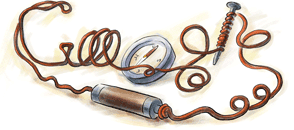
Google Celebrates the Pipe Bomb?

H.C.Orsted

No, today is not the anniversary of the IRA or anything so combustible. It's the birthday of the scientist who is credited with first observing and investigating electromagnetism. But seriously, Google Doodlers, it looks like a time-fused pipe bomb. Listen to the Scribbler on this one.

Thursday, August 6, 2009

Forty Years of Foam Fun

Ah, Nerf. So many fond childhood memories of mine involve squishy footballs thrown around a swimming pool or small yellow orbs of foam propelled at people's heads. This year marks the 40th anniversary of the Nerf brand. Until the juvenile energetic staff at PC World posted this video of themselves trying out the goody-box sent by Nerf, I had no idea it was that old. Hope Nerf doesn't enter a midlife crisis. Although, judging by some of the current product offerings, you might argue that it has. I prefer to think of it more in terms of "product innovation".
Original Nerf


Nerf circa 1969 (Wikipedia)


Nerf Vulcan


Nerf circa 2009 (Hasbro)

If I had one of those belt-fed behemoths in my pillow fort nobody would ever capture my flag. That is, of course, until Nerf develops the N-Bomb, which will unleash massive amounts of atom-sized foam balls annihilating everything within a square mile.

By the way, did you know that Nerf is really an acronym? Watch the PC World video to find out what it is, if you don't already know.

Tuesday, August 4, 2009

Endeth the Empire?

...Uncle Sam is on the verge of paying the City of Los Angeles $30 million to subsidize a ten-year run of Cirque du Soleil.

So it's finally come to pass - America has embarked on the same road down which ancient Rome marched to its ruin: Uncle Sam not only subsidizes bread (by subsidizing wheat production) but now also circuses.

Don Boudreaux - GMU Econ dept. chair

Alex at Marginal Revolution says this is enough to call it the "official" end of us all.

This time the barbarians aren't so much at the gate... they are inside... they are the apathetic, the uninformed, the lazy, the ones who think it's okay for their neighbors to pay for everything, not realizing that their own pockets are in turn being picked. Wake up people, and don't allow your principles, common sense, and personal dignity to be bought off by politicians.

However, as Rome shows the way to ruin, she always lights the way back to prosperity - The Republic.

Thursday, July 30, 2009

Concrete Answers

Sifting through the mail today, I came across an advertisement for the Portland Cement Association on the back cover of a magazine. I stared at it for a moment wondering why the cement trade group would need to advertise in a popular current affairs newsmag. Being the inquisitive bloke I am, I resolved to dig deeper. A quick visit to cement.org gave me the answer, or the "hard" facts if you'll excuse a pun. Federal por... er, stimulus, money. Seems the cement people are lobbying hard to inform you, humble taxpayer, that concrete is far more durable and cheaper than asphalt for road construction. As with so many things these days, the answer is politics and the money trail leads back to Washington. Hey - maybe we can get these guys to fit the Treasury's printing presses with some cement shoes. Now that would be money well spent!

Incidently, did you know that Thomas Edison invented a new process for building with Porland Cement? Nor did I until my recent visit to Edison's home, Glenmont, in West Orange, NJ. It's a national historic park and well worth the trip, particular if you enjoy Victorian art and architecture. And - nerd alert - the Edison Company laboratory is set to re-open in the fall after a 7-year renovation. Seven years, huh? Wow, I sure hope my government healthcare system operates just as quickly as the Park Service!

Disclaimer: that "concrete answers" title came from the cement.org site, much as I'd like to take credit for another zippy pun.

Monday, July 20, 2009

A Giant Leap...

Apollo Mission: 40 Years
It is hard to believe. Forty years ago today man walked on a solitary orb of rock called the Moon. It's hard to believe that three men traversed the chilly vacuum of space to land on a celestial body. It's hard to believe that what was only a dream was achieved in less than 10 years of dedicated effort. In our current times of economic turmoil, when scions of industry and technological change like General Motors can barely produce cars people want and airlines are cutting services, that we as a nation, as a united people, as a human race could join minds to invent and build countless technologies and tools to safely carry people to and from the Moon.

I note this to both highlight how exceptional an achievement the Apollo 11 mission was and to send out a message of encouragement. We can accomplish great things, overcome insurmountable obstacles, and change the way we think about the universe if we devote our time and resources to it. And, if we push the doubters, naysayers, and red-tape dispensers out of the way. Innovation and progress do not result from overseers, lawyers, judges, administrators, or politicians but from risk-takers, hard workers, and all-around bright and dedicated people. While our national leaders can set an agenda, it is for us - the everyday people - to make dreams become reality to the betterment of all mankind. We went to the Moon because we chose to. Not even the sky is the limit to our success when we choose to.

Saturday, June 27, 2009

Automotive Milestone


In case you can't tell, that's 250,000 miles on the odometer of my venerable 1992 Saab 900 hatchback. By sheer coincidence, this occurred just as I turned into a friend's driveway so I was fortunate enough to be able to snap these pics.

What's even more impressive is the minimal amount of maintenance required to get to this milestone. The only power train-related repair was the recent replacement of the crankshaft timing sensor. I'm convinced that the engine on this Saab will outlast every other part of the car. I'm expecting that some day the body will just fall apart all at once, leaving only the motor sitting on the frame. I've taken to thinking of my Saab as though she's the Battlestar Galatica at the end of the Sci-Fi series: a proud, distinguished history; well deserving of retirement yet still called to service; and always a few trips away from busting wide open.

This is the type of quality that Saab was capable of producing before the buyout by GM. In fact, it is not too uncommon for Saabs from the 80s and early 90s to reach 300,000-500,000 miles. My hope is that we will see some wonderful engineering and design work under the stewardship of the new owners of my favorite Swedish brand. Koenigsegg certainly knows how to build things that go very fast, which might pair well with the "Born from jets" heritage of Saab.

Thursday, June 25, 2009

Funny Tees for Nerds


PCWorld.com has a bevy of tech-themed shirts posted today, including the two above that made me LOL. These are strictly for geeks, so get your taped-up glasses pointed over there now. Full slide show here.

Wednesday, May 6, 2009

The Framework

Spring is here and all the plant pods are open. That means my sinuses are closed. Therefore, because I'm feeling a bit loopy, my brain being starved for oxygen, thus putting me on par with your typical elected official, I decided it would be a grand time to lay out what I believe are the critical, necessary characteristics of any good government. This is an easy starter into the bedrock values that underpin my suggestions for the future of the nation.

First, any government should be effective. While it should be obvious that we as a people would want any organization formed for our benefit to be able to efficiently and functionally accomplish its chartered mission, recent history in particular has shown that this is not obvious (see any federal department/bureau/agency, excluding the military).

Second, any government must be simple. By this I mean easily accessible to the average person. Laws, statutes, and regulations should be written as plainly as possible so that every literate individual can be engaged with his or her government and understand what their representatives and agents are doing. A great example would be the federal tax code. Presently, the tax code is 80,000+ pages long. Armies of lawyers and accountants are currently employed to both write and decipher it, which inevitably leads to numerous different interpretations and loopholes. (Also leads to tax "oversights" by supposedly intelligent and informed people like House Ways and Means Chairman Charlie Rangel and Treasury Sec. Tim Geithner. Those would be the guys responsible for respectively writing and overseeing enforcement of the tax code. Ooops!) A simple tax code would be 1 or 2 pages, consisting of such "complex" language as "multiple your income by 0.15. That is your tax responsibility."

Third, good government must be transparent. Transparency dictates that everything the government does, aside from what is related to national security, is open to inspection by the public. It also requires a simple and effective (see above) process for accessing government records, publications, and proceedings. Again, transparency enables the average citizen to remain engaged and knowledgeable about what the government is doing. It can also work to keep politicians and bureaucrats honest (I know, oxymoron.) because everything they do is open to the light of day. Except for the Pentagon, every government office should be a metaphorical clear glass building.

Fourth, good government should be small and limited in powers and scope. This could be two criteria, but I'll treat them as one since they are so closely related. If you consider it for a moment, you will see that small and limited are absolutely necessary qualities if government is to be effective, simple, and transparent. Really, it's intuitive - the larger and more complex something becomes, the less efficient, simple, and easily understood that thing becomes. Does anyone who has every been on the phone with tech support think Windows is simple and effective? Furthermore, I firmly and absolutely believe that you know best for your own life and have the right to the opportunity and power to make those decisions for yourself. Put another way, the closer to you the power is, the more likely that you will achieve the outcome you want. Conversely, the further away from you the power resides, the less likely that decisions will be made that best represent your wants and needs. In practice, your local and state governments should retains as much power as possible while the federal government looks after several critical functions. But at all levels of government, power needs to be clearly deliniated and as as limited as possible. Small and limited government keeps people who don't know you, or answer to you, from making important decisions for you. It also contrainsts ambition, corruption, and greed; and, when government is also simple and transparent, you will readily perceive when those in power are misusing their position. Then you can take action against the transgressors.

Now, some would argue that you cannot have an effective government if it is simple and small. I reject these claims. Such arguments presume that the government knows better than individual citizens and should thus have a wider, deeper role in the affairs of the country. They also assume that the government can do many things better. Beyond several key functions, such as national defense and a justice system, this is laughable and demonstrably false. Think of your own life. Don't you achieve more and get more done when tasks are well defined and you have a simple method to do it? Of course you do! That applies to any organization, including government. The less they have to do, and better defined those tasks are, the more effectively, quickly, and inexpensively can they do it. And, the better you can judge success or misuse of power.

Hopefully, it is clear to you, dear reader, that these 4 characteristics of good government were all instituted at the time of the founding and ratification of the Constitution. These are not radical changes for our nation; quite the opposite. They all exist to one degree or another still. Rather they are a framework for evaluating how well our government is representing us and how healthy our republic is. Unfortunately, our national problems today can be traced to a steady creep away from effective, simple, transparent, and small and limited government. Especially at the federal level. We The People must demand from our government a steady return to strict adherence to these qualities.

Friday, May 1, 2009

A (Red) Banner Day


It is May Day, comrades! And what a glorious day for the proletariat is it. Those vile capitalist corporations General Motors and Chrysler are now securely in the hands of the State and the unions, just as it should have been all along. Dear Leader Obama has justly redistributed the means of production from the guilty financial pigs who took money from the masses and enriched the hapless heads of these vital national industries. If not for these brave moves by the State, the proud workers, whose labor is the root of all production, would have been left robbed of their entitled place in the factory.

Now, the unions, which tirelessly strive for the benefit of the common worker, will direct the activities of the auto giants. In addition, "our friends from Italy" at Fiat will ensure that the latest socially responsible policies from Europe are enacted, and that no trouble is caused by bourgeois provocateurs. Yes, Fiat, which has been slandered by agents of the West with the moniker "Fix It Again Tom" will help bring culturally progressive transportation to the people. Indeed, the compassionate State and its enlightened partners have "fixed it".

Additionally, the banks, which once sought only profit - the evil of all mankind - now follow the will of the State, ensuring efficient transfers of wealth to the unions. The auto makers never need worry about "money" again, leaving them free to maintain proper employment levels that will give a living wage to all workers, regardless of skill or seniority.

Soon, new cars will be rolling off the line. Cars that reflect the glory of the State in ushering forward a future of social equality. Of course, consistent with goals of the progressive society, cars will be distributed fairly, without callous regard for income or status. We can all be assured that the great and wondrous State and the unions will make excellent design selections. These will be cars that you will have no choice but to drive - literally.

Let us give thanks to our benevolent leader Obama and his deputies, and to the people's servants the unions. With our support they will surely extend their wise policies to every other industry. Already we see their efforts in the energy and health care sectors. Hope and Change are upon us! An illustrious May Day. Let us sing...

Wednesday, April 22, 2009

Would You Want This Guy as Your Boss?

A major public corporation was in need of a new CEO. One candidate was a young executive who had been with the company less than 2 years and had never before served as chief executive of any company. However, the search committee and the Board of Directors found him quite charismatic and full of potential. He had excellent rapport with employees, too. The young exec wooed the Board with ideas for increasing employee morale and productivity, boosting sales, and making the firm a true industry leader. This was music to the ears of the Board as their corporation had recently experienced financial trouble and was seen by some in the public and press as out-dated and uncaring toward employees and other stakeholders.

The young exec was eventually appointed CEO and expectations from all quarters were high. The Board hoped that soon their stock price would rise and the company's image would improve as the energetic and eloquent CEO set out to promote the corporation. At a "town hall" meeting with employees, the new CEO stated his vision for the company but offered few details about what strategies would be implemented. He then told the workers that the company was making products that were of questionable quality and safety and that some employees were making too much money.

Next, at the CEO's first major appearance, at an industry conference, he used most of his speech to highlight what he considered the past mistakes of the company. He apologized for these and even indicated that his enterprise had too much market share. Then, rather than note some of the soon-to-launch products of the company, the CEO talked vaguely about products that had so far proven unpopular and unprofitable.

A while later, the CEO announced that the company would be acquiring several businesses in various industries completely unrelated to the corporation's core products. Moreover, these would be hostile takeovers, the existing managers at these firms would be fired, and the CEO and his deputies would take over strategic decision-making for them. This latest move was unnerving to investors because the CEO knew nothing about these new businesses.

Then, the CEO sent out a memo that some managers would be docked pay and denied promotions because the he simply didn't like the opinions they offered on a special task force under the old CEO.

At this point, if you were on the Board of this company, wouldn't you want to know what the hell the CEO was doing? Wouldn't you question what the CEO actually liked about the corporation and why he really wanted to be its leader? If you were an employee or manager, would you want this guy as your boss?

Mull this over and come back in a day or so for the rest of the story.

Tuesday, April 7, 2009

Fiction is Life

I know, I am behind on my Back to Fundamentals, America! pep blogging. Admittedly, I am still a little glum over the end of Battlestar Galactica on the SciFi channel. Not in the same way that Soprano fans were bummed by that series finale. Quite the opposite; I liked the BSG finale. And maybe that is why I feel a longing for more. Quite timely, fiction author Alexander McCall Smith publishes a piece on the "intense personal relationships readers form with characters". He intelligently observes:
Although we eventually learn to distinguish between the world of make-believe and the real world, I suspect that many of us continue to experience fictional characters and events as being, in some way, real. This is because the imaginative act of following a story involves a suspension of disbelief, as we enter into the world it creates. When Anthony Minghella showed me a moving scene that he had just filmed for the pilot of "The No. 1 Ladies' Detective Agency," I found myself weeping copiously, right there on the set. I felt rather embarrassed -- it was only a story, after all -- but he put a hand on my shoulder and said that was exactly what he had done over that particular scene.
A great story, whether fiction or not, touches us in personal ways that we might not fully understand or appreciate immediately.

Now, there was one element of the BSG finale that really tugged at me for some time after watching the episode ... the "life transition" of Kara "Starbuck" Thrace. As I watched Kara announce her time in this plane of existence had come to an end and then vanish I thought it a cinematographically beautiful shot and a fantastic decision by the director. But then my analytical brain kicked in. Wait, she's gone? Does that mean she really did die in the previous season? Is she an angel? I felt there was something unresolved about the character's plot line; moreover, I felt personally unfulfilled. As I spent perhaps a little too much time for a well-balanced person considering this, It slowly dawned on me that this was an appropriate end. It reflects the way people enter and exit our own lives, leaving us wanting more of them after they are gone, but happy for the time we had together. It provokes the question that we ask ourselves (and whatever god you believe in) what role that person plays/played in our own lives.

So, yes, I want more of Kara Thrace. Her exit deprives me of the opportunity to continue the storyline on my own, as Mr. Smith states we consumers of fiction are apt to do. (Of course, in science fiction, anything is possibly, and Starbuck could return - again - but if you are familiar with the BSG universe you know that would not fit with its style.) Yet, at the same time, Starbuck's absence redirects me to focus on the importance of real life family, friends, and acquaintences and what they mean to me. That's good fiction informing real life. As Starbuck's dear friend Lee says upon her sudden and unexpected vanishing, "You will not be forgotten." So it should be with all of us.


Entirely divergent, it seems to me that Ron Moore and the BSG writers are Ozzy Osbourne fans, based on the final scenes of Kara and her husband together in the CIC. Don't know what I'm talking about? Watch the series, starting at the beginning. It's well worth your time. In the meantime, listen to Ozzy.

Kara and Sam say goodbye

Sunday, March 22, 2009

Where to Start

When I took a look back at my posts on the government, politics, etc., I found that my tone was a bit... well... angry. Now, I suppose I am angry at Washington. But I am not an angry person generally and do not like being angry, and anger only takes a person (or a group) so far. Moreover, I want this blog to reflect my more lighthearted side. How, or why did I become angry at our government to begin with? Some would say "unfairness". It's unfair that we responsible individuals should be taxed extra to pay for the extravagances of the irresponsible among us. It's unfair that no one in Washington will accept responsibility for any of the structural problems in the economy. And so on. Yet what is unfairness?

At this point, let me digress for a moment. A common retort to the criticism leveled at Congress and the Obama Administration on their economic policies is basically, "Well, what's your plan then?" Good question. If the plan is not to spend trillions upon trillions of taxpayer dollars (borrowed without asking from future generations) on projects of questionable long-term value, then what should our national policy on the economy, or America in general, be? Another question being bandied about is, "How did we get into this mess?" Also legitimate to ask. In many ways the debate over what we do now as a country reminds me of all those movies about sports teams that start as the worst duds ever but end up as the champs. What always happens in these movies, whether it's the Mighty Ducks or Miracle or Major League? The coach and the team go back to the fundamentals of the game and practice those until they are too tired to stand and so bruised they look like a rotten piece of fruit. Only then does the team move ahead to the more complex and challenging plays. We love these types of stories for a variety of reasons, but in large part because they present the truth: in all things, you need to crawl before you can walk and you need to individually know your position before you can function effectively as a team.

In short, that is what I believe we as a nation need to do. Return to the fundamentals.

Now, back to my anger and the notion of fair/unfair. Essentially, we think of something as unfair if we perceive it to violate one or more of our principles or values. Principles and values are our fundamentals, just like being able to skate well or throw and catch a baseball are foundational in sports. So, I'm pissed because Congress, Obama, the Fed, almost all the way down to Smokey Bear have acted in ways that I think violate basic principles of American society and government. I cannot underscore this enough - I truly think that our Republic is in grave danger; that the America that is the beacon of hope and liberty for the world might just fade away. Therefore, rather than be angry and simply rant, I will propose solutions based upon the principles and values that built this country and that I believe we can (almost) all agree upon. Returning to our fundamentals means, first, knowing what they are, and so that is where I will begin. I think that once we have our principles and values out in clear view, the answers to our national problems and the mistakes that have led to them, as well as the courses of action we should not take, will all become much more evident. And, regarding the actions we should take, even preferable and easier to implement. You'll notice that the title of this post is not a question - it is a statment. We know where to start. Please join me again soon and we'll start together.

Friday, March 20, 2009

Where'd My Wallet Go?

So, I couldn't find my wallet this morning. Looked everywhere for it. Yesterday's pair of pants, under the bed, in the car, on the kitchen counter... Then, while searching, I glanced at a newspaper:

House passes 90% tax on AIG bonuses. (Disregards unconstitutionality of the bill.)

Philly mayor proposes 36% property tax hike, new sales tax in $3.84 billion budget.

Illinois governor wants to raise income tax by 50%.

Budget deficit reaches $1.8 TRILLION.


And my favorite...

Federal government debt greater than the combined income of the the whole world!

After seeing all this I noticed my wallet lying on the floor by the back door. It was empty, except for a business card from my congressman, with the handwritten note, "Sorry I missed you, but thanks for your support." And this in tiny print, "Paid for with taxpayer dollars."

Saturday, February 7, 2009

Spending Our Way to Ruin

Okay, I've had enough. I withheld posting on politics during the election cycle, but now the fools and tools in Congress and our Chief Executive of Hope and Change are about to commit highway robbery of unprecedented proportions. First the House passes a bill that is estimated to cost the American taxpayers $820 Billion. I might point out that only Democrats voted for this, with 11 D's crossing over to vote 'nay'. Now the Senate - at least the Dems and a couple spend-happy Republicans - seems poised to agree to about $800 Billion.

Let's be clear here. This is not "economic stimulus". It is government spending, pure and simple. Obama said so. (Sorry about the Canadian thing, but this was the best version I could find quickly.) What is the difference you ask. Well, stimulus implies that you get some sort of positive ripple effect through the economy or boost in total value (GDP). Supposedly, we will see more jobs, better incomes, and such. This spending will not achieve this goal because it is no different than the typical congressional appropriation. These bills just buy stuff for government - federal, state, and local. There is no real investment of the sort that individuals and businesses make to create added value. Think of it this way. The feds are going to pay a lot of people to build federal offices, install computers, pave roads, etc. So beyond the paychecks of these select, lucky people there will be no value added to the national economy. At the same time, a massive amount of money will be taken out of private hands, which means that when creative and innovative folks come along saying, "Hey, I have a great idea for a better mousetrap", there will be no money for them to do it. So the jobs that would have otherwise been created at the new mousetrap factory, jobs that would last more than the time it takes to install a faucet in a national park outhouse, will never materialize. Here's an even simplier analogy: Could you ever afford to buy the things you really want or repair your car or house, or save for retirement, if you were constantly giving your hard-earned money to your wacky neighbor who only used your cash to add more garden gnomes and floodlights to his yard?

The other important fact is that Congress has to borrow or print all this money, or both. None of those are good options for our nation. First borrowing. We all agree that the root of our economic problems is the reck-loose borrowing and spending of consumers and businesses. Now we are being asked, in a most insulting way, to believe that the way out of our debt is to take on more debt for things we don't really need. Second, printing cash. Inflation. INFLATION. INFLATION! Click here if you don't know why inflation is a bad, bad, bad thing for America.

Speaking of debt... Think you are a fiscally responsible person, with a handle on credit card and consumer debt? Think debt isn't a problem in your life. Oh, aren't you a cute little deluded American. The recently-retired Comptroller of the Currency, the guy who is basically the head bookkeeper for the US, estimates that each American (not just taxpayer, each American) owes $184,000 on the national debt. And that figure keeps rising. Sooner or later, that bill will come due in the form of much higher taxes on everyone.

Back to this spending spree package. What's in it? Good question. The bill from the House is almost 200 pages long and sheds little light on what we taxpayers are actually spending money on. However, here are a few choice porkers:

  • $2.825 Billion for broadband internet for rural communities.
  • $650 Million for coupons for analog-to-digital television converters
  • $140 Million for "climate modeling" (I thought the science was settled on that one?)
  • $7.7 Billion for the Federal Buildings Fund
  • $150 Million for the Smithsonian
  • $50 Million for the National Endowment of the Arts
It just goes on and on, the wasteful, special interest-payback, vote-buying spending. In many cases, such as spending for the Dept. of Education, the appropriation in this emergency "stimulus" bill is twice the normal annual budget amount! The extra shame is that all this pork will inevitably be added to the federal baseline, meaning that it will be used to calculate next year's budgets. So, in a few strokes of the pen, government will have ballooned in size, power, and thirst for our money, all under the disguise of helping the little guy and gal.

All is not lost - yet. The Senate has not voted and the president hasn't signed anything into law. Take this opportunity to call, fax, email and generally pester your elected representatives into stopping this raid on our wallets and liberty. Because that's what this is all about - making everyone a recipient of government welfare. And that's just another way of saying losing your freedom. WE THE PEOPLE deserve much better. We deserve to be respected and listened to by our government. But only if we speak up. Go now and give them your opinion.

Monday, November 3, 2008

A Yankee Endorsement


The Brain has a platform that I can get behind:

Wednesday, June 25, 2008

Travel Day

I'm off to Washington, D.C. and vicinity today. Just hope this doesn't happen to me...

Sunday, June 22, 2008

Ramsey's (Senate) Kitchen Nightmares

Inspired by the recent stories of the mismanagement of the U.S. Senate dining hall and associated eateries, I started to think about how that master of restaurant revitalization, Gordon Ramsey, would handle the situation. I think it would go a little something like this...

Ramsey (voice over): I'm in Washington, D.C. at the Dining Hall of the United States Senate. You'd think that the puff-chested windbags that run the place would demand first-class service, but the restaurant is a mess. It's lost money almost every year it's been in operation. Last year alone, the Senate restaurants were $2 million dollars in the red.

Ramsey (walking into dining room): F#@* me - nobody is in here. It looks like the cafeteria on a battleship. It's so dark and institutional. Let's try the food.

(Sampling something lumpy and the color of card board) Christ! I've had better food in a Malaysian petrol station. I don't know how the senators are going to explain this.

(Cut to Ramsey talking to several Senators) Ramsey: So, you're losing money.

Sen. Diane Feinstein: Yes.

Ramsey: Do you eat here? Do your staffers eat here?

Feinstein: No, all the Senate staffers seem to eat on the House side of Congress.

Ramsey: Doesn't that tell you something?

Feinstein: Our staffers are working hard with their colleagues in the House on important legislation for the American people... (drones on)

(Cut to Ramsey walking out of building) Ramsey: These senators are clueless. Neither they, nor their own staffers will go anywhere near the f*^@ing Dining Hall, yet none of them will lift a f$!@ing finger to do anything about the absolutely awful state of things. Only two new menu items have been added to the menu in the past ten years! No wonder nobody wants to eat here.

If I ran my restaurants that way, I'd be putting a "closed" sign in the window before the next election.

(Cut to Ramsey back in kitchen with Senators) Ramsey: Do any of you have experience managing a restaurant?

Senator: I sit on the Agriculture committee.

Ramsey: I want you to look at this kitchen. (Cut to scene of dirty dishes, greasy stoves, and wilting vegetables) Would you want your kitchen at home looking like this?

Feinstein: Of course not! I'd fire the cook and housekeeper if they left this mess for me to see!

Ramsey: Do you see all this food, the stuff that is just rotting on the counter? This is all just f^&#ing wasted. You might as well just pay your staff to throw food in the trash. Actually, if that gruel that I was served earlier is any indication, I'd recommend you pay them to throw it all in the garbage.

Why don't you fire these incompetent sods and get some real cooks in here?

Feinstein: It is our obligation to provide a well-paying job to these hardworking people, many of whom are disadvantaged and... (drones on)

Ramsey: But they are costing you millions!? You are losing money everyday by not changing.

Feinstein: These people are contributing to the economy of the... working mothers... ex-felons... minority advancement... undocumented workers... the American people understand that their tax dollars go to good causes subsidizing the jobs of...

Ramsey: I want you to seriously consider hiring a professional manager.

Feinstein: That sounds like privatization! We can't outsource this vital function of government!

Ramsey: Get it in your head, no one is eating here. This food isn't fit for a dog. You would be charged with aggravated assault if you gave the daily leftovers to the homeless.

Feinstein: I've worked hard to provide for our noble but displaced...

Ramsey: I give up. You f^#$ing politicians are entirely blind to what obviously needs to be done here. I just can't figure out if you are in denial, a complete idiot, or just like things being complete f@&%ed.

Thursday, May 29, 2008

Milestone or Inflection Point?

I suspect that today is the last day I will ever pay less than $4 for a gallon of gasoline. I saved the receipt from the first time I paid more than $3 a gallon - it was just after Hurricane Katrina hit when there was wide concern that gasoline deliveries would be interrupted. Here is my prediction: the internal combustion engine is doomed. It's tombstone has already been carved and is just waiting for the DoD to be added by an alternative. My bet is electric or hybrid electric originating from nuclear plants. Corn ethanol is a complete folly. Actually, any agriculturally-based fuel input, be it switch grass or sugar or otherwise, is a bad idea as it will invariably compete for farm land with food products. The world wants to eat more than it wants to drive and the backlash will only continue if we don't wise up to basic realities.

However, for the time being, the oil companies are providing a safe harbor for investors weary of the fall-out from the housing/financial market crunch. Oh, yes, some decry the profits of ExxonMobil, et al. But their arguments mostly neglect the facts that Big Oil is losing money on refining operations, their overall margins are a mere 8%, and the largest shareholders of the energy companies are mutual funds and pension plans. So, retirees, teachers, policemen, and all sorts of individuals with retirement accounts are personally gaining from the profits. Probably no comfort to you, but remember that when politicians and other "activists" yap about "windfall profits" and new taxes, it will really mean less money in the pockets of senior citizens and public-sector employees.

Back to alternative fuels... the company that can provide a fuel with the energy equivalent of a gallon of gas at $1 per unit is going to make a lot of money. A lot. I call that opportunity.

Friday, May 23, 2008

Constructive Criticism

The astute are aware that I link to the blog of my buddy, Ballista. Now I want to proffer some advice to my friend. Lay off the third-person references. I know you are a secretive sort, but use some pronouns every now and then. You are going past the silly Norm MacDonald/Bob Dole thing and entering into freaky territory. I'm just saying.

And when did you turn into the all-Russia, all-Red alert, all-the-time blog? We get the point (hehehe). I miss the cutting sarcasm of old.